
Blog
The night the supermoon slammed many traps: why ten mice fell in 24 hours
Dec
My mystery of a mouse in the moonlight
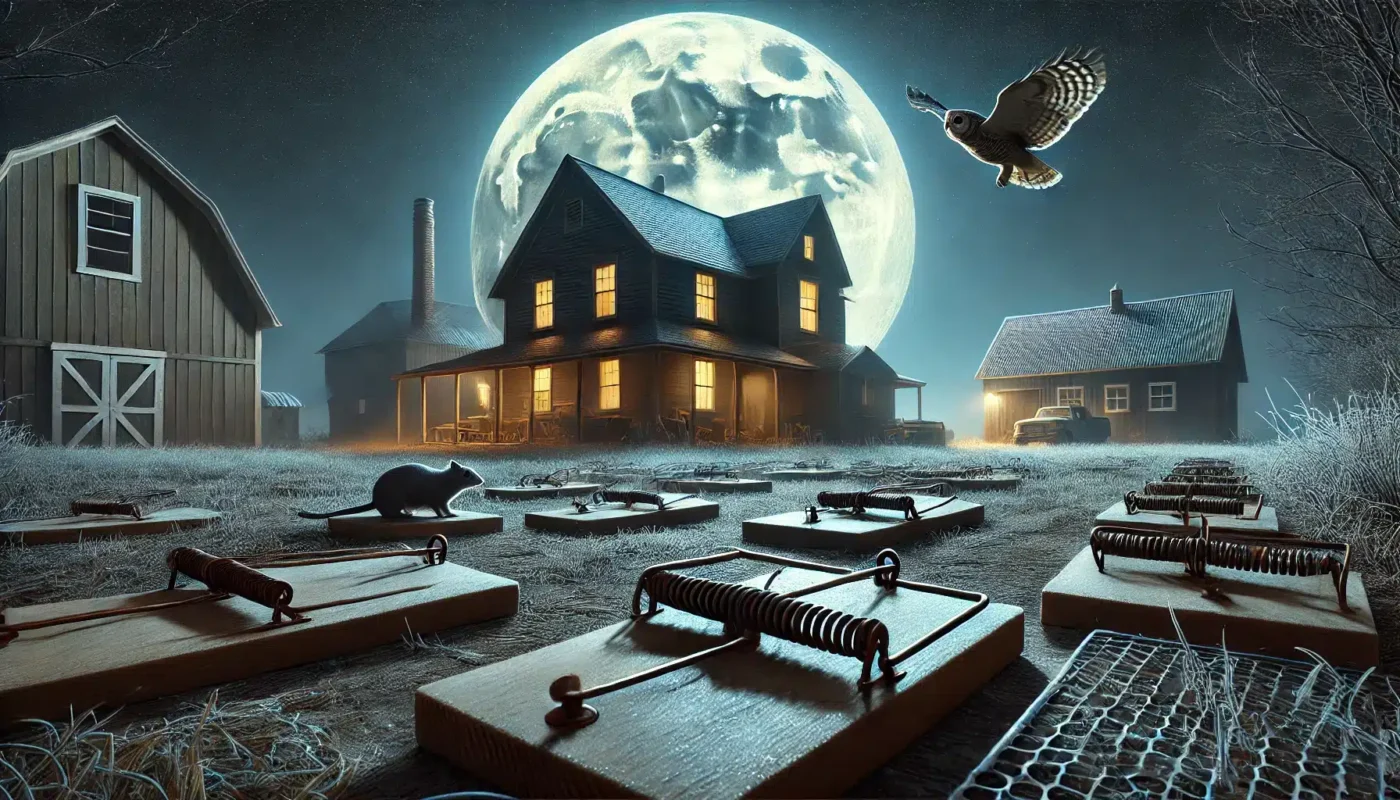
Last week, the supermoon showed us its glow, and the big full moon bathed everything here in northern Illinois in silver light. At the time, I wasn’t thinking about rodent behavior or any lunar-powered mammalian movements.
But I caught a few mice and tried to keep them out of our home space. So I kept loading up on traps and peanut butter. But catching ten mice in twenty-four hours under a blazing white sky is no mere coincidence. Whether you realized it or not, I had stumbled upon one of nature’s quiet little mysteries… does the moon actually change the way mice move?
And when you start asking this question, things get really interesting.
A supermoon, ten mice and a question that can’t be ignored
While the supermoon bathes the night in cold light, the real work is happening down here – one warm lamp, a few mousetraps, and the host quietly reclaims the pantry.
Ten mice in one day is not background noise. This is a sharp increase. People who live off the grid, on small farms next to grain fields or in older homes, know what it usually looks like – long quiet stretches, then sudden bursts where the traps keep popping. But when that flare coincides perfectly with a supermoon, you stop and wonder if the sky itself has flipped a switch.
This experience gave you a rare, crystal clear data point. It wasn’t one unlucky mouse or one lucky trap. It was a whole small wave of motion compressed into a tiny window of time. And such clusters almost always indicate timing. The question is: with what at the right time?
Full moons – and especially supermoons – change the night dramatically. Even without a single scientific publication in hand, it’s obvious that a creature built around darkness and concealment may behave differently when midnight suddenly becomes dusk.
Why bright moonlight makes mice behave strangely
In the wild, mice, voles and other small mammals live under constant threat from owls, foxes, cats and a long list of keen hunters. For this reason, scientists name many species “moonphobic.” In short, they hate bright moonlight.
Decades of field research show that on clear nights during the full moon, surface activity often drops dramatically – sometimes by half or more. The brighter the night, the easier it is for predators to see movement. The glowing field is basically a dinner plate.
But here’s the twist.
Less activity in open spaces does not mean less movement everywhere. Instead, rodents change the way they move. They abandon open passages. They adhere to the edges. They lean against walls, glide along hedges, follow fence lines, and dive into the tightest shadows they can find. Their movement is squeezed into tighter, more predictable channels.
And this is where the whole night of ten mice begins.
When the Moon “pushes” mice straight into your traps
If your traps were set where mice naturally feel safest – along walls, behind appliances, near foundations, in the corners of barns or in tight runways – you’ve already been waiting in the same strips where a bright moon would force them.
On dark, cloudy nights, mice risk more. They roam wider. They travel through open spaces more freely. Their movement extends in time and space. Some ended up in traps. Many don’t do this.
On the bright night of a supermoon, the rules change.
Suddenly, open spaces seem like dangerous oceans of light. Mice become cautious to the core. They have limited roaming. They compress movement into short, urgent bursts when they absolutely need to move—often just after dusk or just before dawn. Most importantly, they repeat the same safe routes over and over again.
From your side of the wall it looked like an invasion. There was a sense of desperation on the mouse’s part – moving as little as possible, in the darkest and tightest places available. And right there, calmly waiting, your traps.
In my case, I guess it wasn’t really “more mice”. It was the same local population squeezed through several narrow corridors that I happened to control with traps.
Why full moons can make your traps suddenly seem ‘overpowered’
Think about contrast.
On the night of the new moon, the darkness gives mice opportunities. They can improvise. They can explore. They can spread risk across multiple paths and hours.
On the night of a supermoon, the sky itself becomes a predator.
Movement becomes purposeful. The routes become stiff. Behavior becomes predictable. And predictability is exactly what traps thrive on.
What seemed like a strange spike in deaths actually meant a spike in interceptions. I didn’t suddenly become ten times better at trapping. The moon simply made the mice ten times more predictable.
Other forces likely caused this increase
Of course, the Moon rarely acts alone. When you see a sudden wave like this, there are usually several forces colliding at once.
Season and weather also play a role. Cold, rain or the first hard frost push mice indoors in search of warmth and solid food. If this push occurs during a full moon, there will be both an influx and a change in behavior.
Changes in food and shelter also make a difference. Moving feed, cleaning grain, harvesting crops, disturbing old nests or breaking up clutter can disrupt their routine and force them to relocate. When the pressure drops during a bright moon, the movement becomes compressed and intense.
Predator pressure adds another layer. An owl hunting under a bright sky turns fear into strict discipline. Mice become even more restricted and even more tunnel-oriented.
When all three elements – seasonal pressure, disrupted shelter and a supermoon – come together, your traps can suddenly feel “supercharged,” as if nature had given you a cheat code.
Turning lunar science into real-world household strategy
Okay, you don’t have to become a lunar scientist to benefit from this. My Night of Ten Mice points to a simple, practical strategy: use the full moon as a tactical window.
A few days around each full moon, refresh each trap. The old bait is drying out. The springs are weakening. Reset everything as if you were preparing for a storm.
Double the edges and cover. When the sky is clear, think like a victim. Any place that offers shade, a solid wall, a low ceiling, or a narrow gap becomes a highway. This is where traps work best.
Use the Moon as an early warning system. If you already know that fall and early winter drive mice toward buildings, combine your hardest trapping efforts with these bright moonlight windows. Even if your overall activity drops, the traffic you do make will be concentrated right where you can capture it.
At the same time, check for new gaps, seal entry points and remove attractants. The day-of-ten-mice swoop is a loud signal that a population has gathered nearby and is actively testing your defenses.
When a weird night becomes a long-term advantage
What started as a strange coincidence – a supermoon and ten mice – actually lines up with what biologists have been observing for decades: The moon changes its behavior at night.
My experience turned this abstract science into something real and practical. It showed me when mice were most likely to follow narrow paths. It also showed me how fear and light can turn chaos into predictability.
Instead of dismissing this evening as a freak accident, it’s worth treating it as a pattern worth watching. Pay attention to the phase of the moon, the weather, the time of year and the location of traps. Over time, you may find that your biggest windows of success center around bright, clear full moons — especially when seasonal pressures like cold snaps are already pushing those little ones closer to your walls.
In this sense, the supermoon didn’t just light up the sky. It revealed the hidden rhythm running through the smallest creatures sharing your space. And once you learn this rhythm, your mouse problem won’t go away – but it will become a little more predictable and therefore a lot easier to master.
Happy catching!
