
Blog
When the forest bites back: How laboratory tick diseases can first infect people living off the grid
Dec
Where forest life meets government ticks
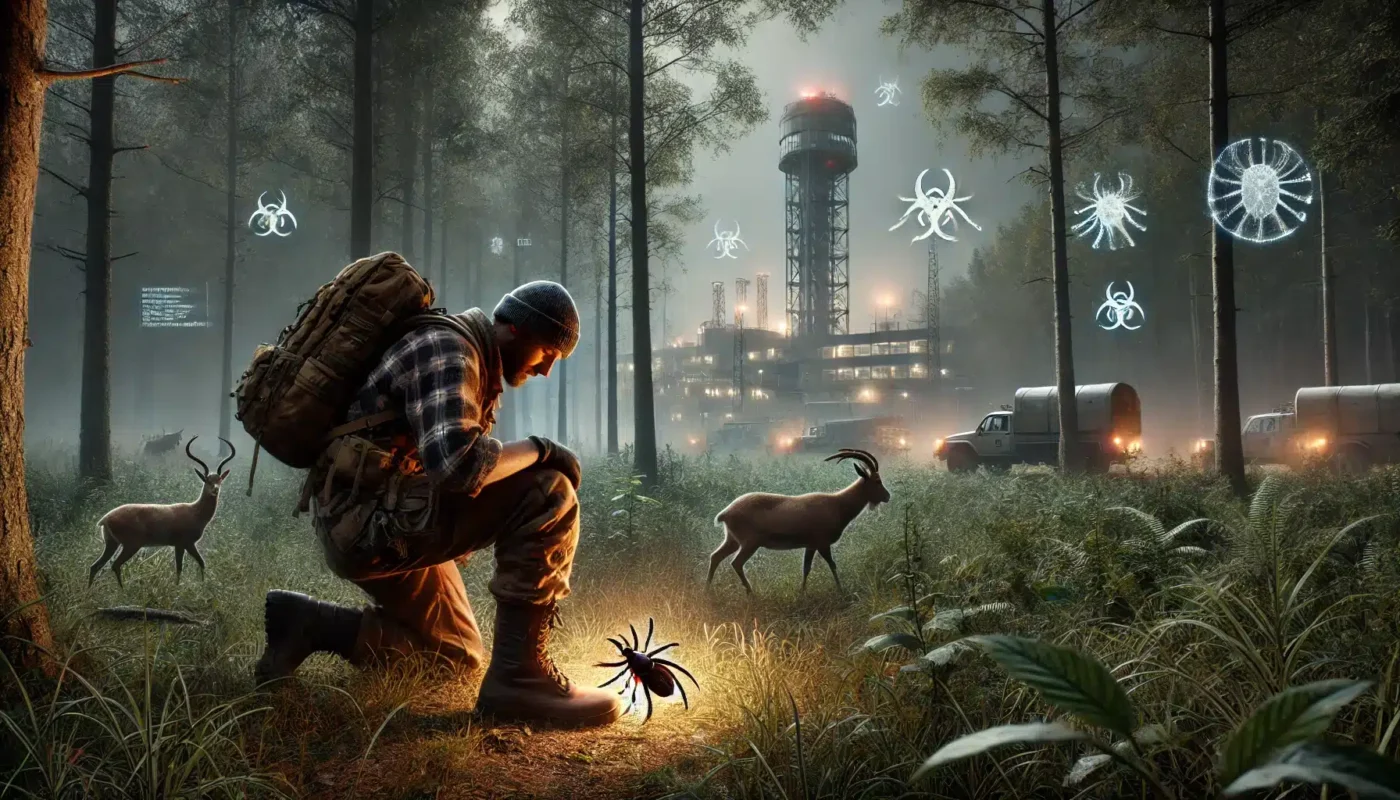
Imagine this: you are deep in the forest, many kilometers from the nearest paved road, in a place where you only receive signals of the wind flowing through the pines and the chirping of birds settling down for the night. You put down your backpack after a long day of foraging, hunting, or checking cattle in a remote pasture. Then this happens – you feel something on your ankle. The tick, as small as a speck of dirt, is already burrowing into the skin.
For most people outside the web, ticks are old enemies – irritating, stubborn, but familiar. But lately, a darker question has arisen with every bite. What if the tick on your skin didn’t come from the forest at all? What if his ancestors came from an American laboratory breeding exotic species linked to deadly diseases?
Because it’s not fiction anymore. Recent investigations have found that many U.S. labs are importing live African ticks – the kind that spread Crimean Congo Hemorrhagic Fever (CCHF) – and breeding them in colonies here in America. This emerging threat particularly affects those who live, work and hunt outside city limits, far from hospitals and quick medical attention. In tall grass and bushes you won’t get a second chance.
A deadly disease from abroad… imported on purpose
In the shadow of America’s cattle country, tiny, lab-grown ticks wait behind glass for one serious bug.
First, let’s talk about CCHF. Scientists first encountered it during World War II on the Crimean Peninsula, and since then the virus has become a terror. Imagine a fever that skyrockets like a blowtorch, headaches that feel like a cracked skull, and internal bleeding that can turn your organs to mush. CCHF kills between 10 and 40 percent of its victims, usually in the second week – right when people think they are nearing the end.
And the tick that spreads it is Hyaloma, he’s not your average slow-moving hitchhiker. These things are fast. They hunt. They are chasing. They run across bare skin as if they had somewhere to go.
In places like Africa, Asia, southern Russia and the Balkans, CCHF is a known killer. But here’s something shocking: we don’t have CCHF in the United States. Or rather we didn’t…until labs started importing disease-carrying ticks for research purposes.
For off-grid families combing tall grass or farmers checking on goats and sheep at dawn, it changes the whole game. It’s one thing to avoid diseases that are already here. It’s one thing to fear that the next tick might emerge with a virus that was never intended for North America — and that was delivered unintentionally by a lab accident.
From Plum Island to the Prairie: Why Kansas? Why now?
Next, let’s look at how this threat made its way from distant shores to America’s heartland.
The White Coat Waste Project, a government watchdog, has been unveiled 10 USDA contracts linked to the development of an mRNA vaccine – specifically targeting CCHF. These contracts fuel research at the Agricultural Research Service in Manhattan, Kansas, in collaboration with the National Bio and Agro-Defense Facility (NBAF), a new high-security national animal disease laboratory.
NBAF was once headquartered on Plum Island near New York City, a remote location intentionally isolated because of the type of pathogens it studied. But now? It’s right next to cattle country.
Breeding activities extend in all directions. Farmers without access to the grid raise goats, sheep, cattle and pigs near these facilities. Add to that partnerships with UC Davis in California and Texas Tech in Lubbock – two other animal breeding facilities – and suddenly the CCHF tick research map begins to look eerily close to the places where animals and the people who care for them live and work in daily contact with the land.
If you care for animals in isolated areas, it doesn’t take much imagination to see how one lab error can impact your world. The line between “limited experiment” and “new epidemic in America” is getting thinner quickly.
Breeding exotic ticks in the heart of America
This is where the story tightens up.
These labs don’t just test for existing bugs. They are breeding colonies of African Hyalomma ticks— fast, aggressive and highly infectious ticks — at the heart of our livestock industry.
In closed rooms, technicians breed imported ticks, infect animals and study how the virus spreads. Beyond these rooms, the Kansas farmland stretches to the horizon, dotted with cattle, bison, deer, coyotes, and all the wildlife that ticks love to feed on.
The USDA says this research prepares us for possible epidemics. Critics say this can cause them.
And history gives these critics plenty of ammunition.
History repeats itself – especially when it comes to ticks
Kris Newby, a Stanford science writer who wrote Bitten: The Secret History of Lyme Disease and Biological Warfare, he spent years interviewing retired lab workers and searching for secret documents. Her conclusion: America has a long history of sloppy research on ticks spreading into the wild.
He points to Willy Burgdorfer, the scientist who discovered the Lyme disease pathogen. According to Newby, Burgdorfer oversaw tick projects so risky that new technicians were bitten on their first day by the fast-moving African tick species. One of these technicians became seriously ill.
Other tick shipments sent to Canada reportedly contained unexpected pathogens that forced the destruction of entire colonies before spreading to local wildlife.
Then we have an almost unbelievable story Dr. Daniel Sonenshine releases 152,000 radioactive lone star ticks on the East Coast in the 1960s. Shortly thereafter, cases of Rocky Mountain spotted fever appeared in places where it had never been recorded – Montauk, Long Island – and then spread throughout the country.
For those outside the network, these stories were powerful. You know exactly how often you remove ticks from your neck, legs, clothes and farm animals. If something exotic ever leaks, you’ll be first in line to encounter it.
Modern research, old problems: the mRNA angle
Let’s move on to the technology behind it all: mRNA vaccines.
The USDA has allocated money to develop mRNA vaccines against CCHF and other foreign animal diseases. Meanwhile, EcoHealth Alliance – the same group linked to the Wuhan takeover fiasco – received $3.7 million Department of Defense grant study CCHF in the “weapons of mass destruction” category.
This sentence alone should catch your attention.
Some mRNA shots for pigs are already licensed abroad. Here in the U.S., we don’t yet have cattle or other livestock operations, but farmers are feeling the pressure.
Dr. Brooke Miller, A Virginia cattle rancher interviewed by The HighWire said he stopped vaccinating his herd for a year and saw pregnancy rates close to 100 percent — compared to the usual post-vaccination abortions of 4 to 5 percent. Pig farmers using Merck’s Sequivity mRNA injections must sign non-disclosure agreements.
In a world off the grid, where people raise their own eggs, meat and milk, the thought of forced injections of farm animals – especially experimental ones – hits like a punch in the gut.
African swine fever, MIT and other imported threats
The USDA also funded an MIT project to develop mRNA vaccines against African swine fever, a virus that kills nearly 100 percent of infected pigs. It never made it to the United States, but labs are now importing the virus — and young piglets — to test mRNA therapies.
Piglets as young as four weeks old are injected twice, euthanized and dissected for data.
For critics like White Coat Waste’s Justin Goodman, it’s another case of government labs introducing foreign diseases, breeding foreign vectors, and trusting that human error won’t open the door to disaster.
If the past is any guide, this is a foolish assumption.
Why can’t people offline ignore it
Here’s the brutal truth:
The people who spend the most time outdoors – hunters, gatherers, settlers, botanists, field workers, farmers – are the ones who will be the first to encounter exotic pathogens if something leaks. Not city dwellers. Yes, You.
Ticks don’t care about boundaries. They hitchhike deer, rabbits, birds, coyotes and farm animals. Each season they expand their assortment. And when a new species or virus takes root, good luck stopping it.
Therefore, this issue has significance far beyond laboratory policies and protocols. It’s about protecting the people living closest to land.
Stay safe when labs won’t
Until the research landscape changes, offline families should focus on the basics:
- Treat shoes, pants and backpacks with permethrin.
- Every time you come out of the bush, check from head to toe for ticks.
- Dogs and farm animals should be treated and controlled.
- Carry an appropriate tick removal tool.
- Be vocal, stay informed and stop risky government research that brings foreign pathogens to American soil.
Because once a new disease gets outside the lab, no fence, no distance, no off-the-grid hiding place will be able to keep it off your back.
